
Mosquitoes in Alaska: What You Need to Know
This article may contain affiliate links, meaning if you make a purchase, I may earn a small commission at no extra cost to you. As an Amazon Associate I earn from qualifying purchases. See my Disclosure Policy for more information.
Setting out on an Alaskan summer adventure means coming face-to-face with the state’s legendary wildlife, including its less celebrated but omnipresent residents—the mosquitoes.
Often humorously dubbed the “Alaska State Bird,” these voracious little critters are a force to be reckoned with. I’ve become quite familiar with their spirited presence after living in Alaska for seven years and visiting our cabin there in the summers.
Those tiny yet formidable adversaries, with their incessant buzzing and insatiable thirst for blood, became an integral part of my Alaskan experience.
In this blog post, I’ll delve into the intriguing world of Alaska mosquitoes, exploring their unique characteristics and survival strategies.
I’ll also share essential tips and tricks to help you navigate the buzzing onslaught, from choosing the right repellents and clothing to finding refuge in the Alaskan wilderness!
❗️In a Hurry? Here are the Survival Kit Essentials 🦟
- Mosquito Repellent: Choose a Picardin-based repellent such as Sawyer, which is EPA-approved, or a DEET-based repellent with a high concentration to effectively deter mosquitoes.
- Long-Sleeved Clothing: Opt for lightweight, breathable garments that cover your arms and legs to minimize exposed skin.
- Head Net: A fine-meshed net that fits over your hat or headgear can provide additional protection for your face and neck.
- After-Bite Treatment: Pack an anti-itch cream or soothing ointment to alleviate discomfort in case you do get bitten.
Alaska Mosquitoes
Alaskan mosquitoes inhabit most regions of the state, primarily areas with abundant water and a climate that supports their life cycle.
Year to year the level of mosquitoes fluctuates but if you experience a bad mosquito year you won’t ever forget it!
They are more prevalent in open tundra, the Interior, and the Far North between the Arctic Ocean and the Yukon River. They also thrive in marshy areas, bogs, dense forests, and near rivers, lakes, and streams.
More than 17 trillion mosquitoes hatch and flourish in Alaska each year and they can breed with shockingly low amounts of water.
They thrive when the weather warms up in the spring and water sources start to thaw so a wet spring brings more mosquitoes.
If you want to avoid them as best as you can then avoid visiting during certain months; the mosquito population is greatest in June and into early July, but they can even appear in late May depending on the year.
Having traveled all over the state during my 7 years living there, I can assure you there is not anywhere in Alaska you can escape these pesky insects in June unless you are inside, or are going hiking or camping on a glacier!
The good news is that Alaskan mosquitoes do not transmit diseases harmful to humans. Although the species that transmits West Nile virus is present in Alaska, the disease has not come with it.
Alaska’s Mosquito Species
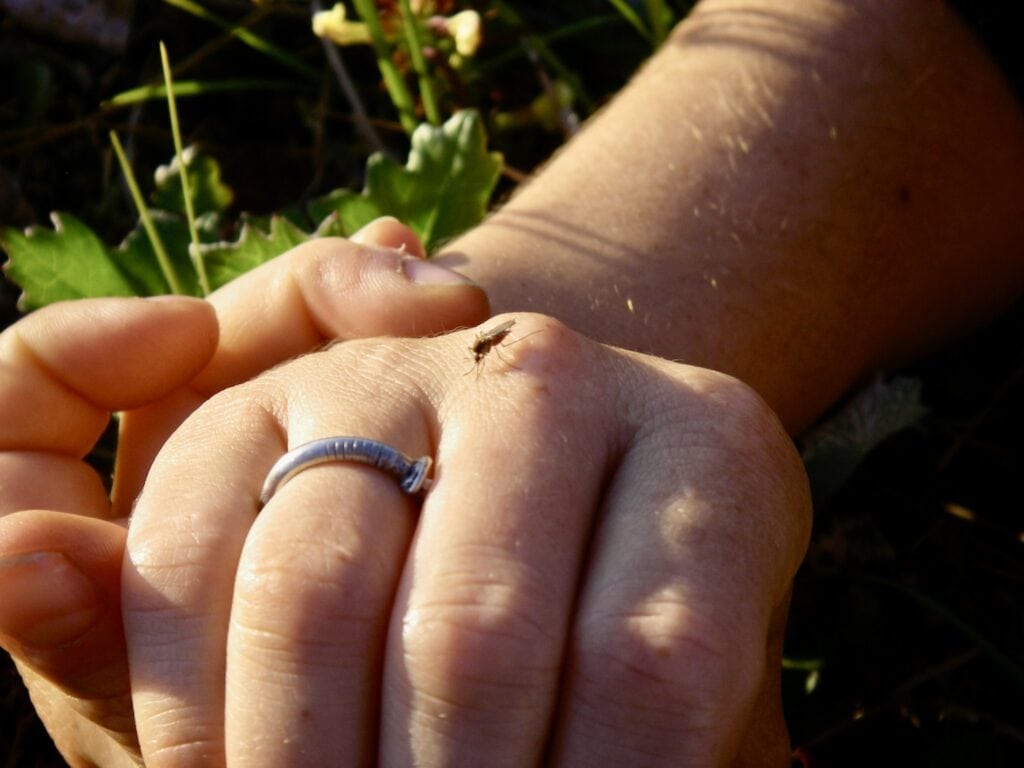
An in-depth study of mosquitoes claims there are 35 known species in the state, giving Alaska the prize of having more mosquito species than any other state in the country.
Mosquitoes in Alaska fall under four genera:
- Aedes
- Anopheles
- Culex
- Culiseta
Three species in Alaska (Aedes communis, Culiseta alaskaensis, and Culiseta impatiens) are called snow mosquitoes because of their size, geographic range, and method of overwintering. They emerge in early spring, often six weeks earlier than other species.

Life Cycle of Mosquitoes in Alaska
The mosquito life cycle consists of four stages:
Egg ➡️ Larva ➡️ Pupa ➡️ Adult
Females lay eggs in water. Eggs overwinter, hatch, and develop in moist and aquatic environments.
Eggs develop into larvae, which feed on microorganisms and molt several times before they become pupa.
After the pupa hatch, adults leave the water source and take to the air to mate.
The duration of the life cycle of mosquitoes varies according to the species and environmental conditions.
- Adult males live for about seven days.
- Females live about six weeks. Females of the Alaska snow mosquito can live more than a year.
The eggs and larvae of Alaska mosquitoes can overwinter in temperatures below zero. When spring arrives and water temperatures rise, development begins.
The snow mosquito overwinters as an adult, hibernating in leaf litter or tree bark, tolerating temperatures as low as 25 degrees below zero. In the spring, this is the first species to emerge.

Deep Dive: Surviving Alaskan Mosquitoes
There are ways to survive the Alaska mosquito season and if you are lucky during your stay it won’t be one of the “bad” years. If you are in mosquito-infested areas, there are ways to protect yourself, or at least try to!
I recently experienced one of the worst mosquito seasons I remember in McCarthy, Alaska, during our month-long stay at our cabin there. Mosquito netting, bug repellent, and staying indoors were the only ways to attempt to feel sane from the swarming.
It was so bad no one in my family wanted to wash the dishes (we wash them outside with camping sinks due to having a dry cabin, which means it has no running water) and we absolutely dreaded having to use the outhouse! Naked legs and bottoms offer quite a treat for mosquitoes!
If you experience large mosquito populations during the Alaska mosquito season you can reduce the impact by camping in sunny spots, staying in areas with a cooler breeze, using insect repellents, and wearing clothing that protects you from bugs.
In areas with a high density of mosquitoes, I strongly recommend you wear head nets and bug-repellent clothing.

Essential Tips for Mosquito Protection
These essentials will equip you with the necessary tools to tackle mosquitoes and enjoy your time outdoors in Alaska with reduced annoyance and discomfort.
✔️ Wear protective clothing
- Wear loose-fitting, long-sleeve tops and full-length, long pants. Tightly woven cloth prevents mosquitoes from biting through the fabric. In the photo above you can see I am wearing a rain jacket despite the hot weather – it was the ONLY way I could not be bitten!
- If needed, tuck pants into boots or shoes and wear thin gloves. Light colors are not as attractive to mosquitoes as dark or bright colors are.
- Look for clothing with insect repellent embedded in the fabric. Long sleeves are preferred. Some camping gear, including tents, blankets, and nets, are made with repellents.
- Avoid scented shampoos, perfumes, or other scented products that attract mosquitoes. They can be actual mosquito magnets.
✔️ Wear mosquito netting
- If you go into heavily infested areas, use a mosquito head net. Make sure to buy a good quality net that covers your entire head and neck. They come in many shapes and sizes so find the one that fits best for you!
- Wear a hat with your mosquito head net. Either a bucket hat or a baseball cap will keep the netting off your eyes and face.
✔️ Stay indoors during peak mosquito activity
- Choose times when mosquitoes are less likely to be active and locations that minimize exposure. Mosquitoes are most active during dawn and dusk, so try to limit outdoor activities during these times when possible.
✔️ Consider weather conditions
- If you plan outdoor activities, pick locations in the sun instead of the shade. Mosquitoes thrive in damp and stagnant environments
- Mosquito activity reduces when winds are faster than the insect’s flying speed. Combinations of drops in temperature, rain, and wind affect mosquito activity.
✔️ Bite Relief
After Bite is a wonderful product to have on hand because coping with mosquito bites can be a challenge! Most people experience itching and a raised area around the bite. Small children and people with immune system disorders may have stronger reactions, such as raised welts, intense itching, hives, or fever.
👉 If you have bites that are bothering you, wash the area with soap and water, apply ice, and use topical ointments that reduce swelling and itching. For a home remedy, apply a paste of baking soda and water to the bite. Wash it off after 10 minutes.
✔️ Bug-Proof Tent
Are you camping in Alaska? Invest in a well-sealed tent with fine mesh screens to create a safe haven from mosquitoes during outdoor activities or camping. This ensures that your sleep will be comfortable and free from any flying pests.
Mosquito Repellents for Alaska
✅ Mosquito repellents are a must in Alaska! I will be completely honest and say there are times when bug spray does not deter these suckers, it has to be said out loud.
However, the most highly recommended and effective repellents contain DEET. However, DEET can have strong smells and even be toxic if ingested. It can, very rarely, cause skin irritation for some people.
DEET is not my favorite because it feels very oil on my skin and also damages synthetic fabrics.
DEET: DEET products come as sprays, creams, lotions, and liquids in concentrations ranging from 4% to 100%.
The percentage of concentration refers to how long the repellent lasts, not how strong it is. Lower concentrations may have to be applied more often.
🦟 TRY Cutter Backwoods Dry Insect Repellent, Mosquito Repellent, 25% DEET
PICARDIN: Picaridin is a synthetic derivative of the pepper plant and is a very effective ingredient in mosquito repellents. Picaridin works by effectively blocking the receptors that mosquitoes and other insects use to detect humans.
Unlike DEET, Picaridin is odorless, non-greasy, and does not dissolve plastics or synthetics, making it more comfortable and convenient for many users.
🦟 TRY Sawyer Products Picaridin Insect Repellent Spray, 20%
PERMETHRIN: Permethrin is a synthetic insecticide that mimics the chemicals in chrysanthemum flowers. It can be applied to clothing and skin.
When permethrin is applied to clothing PLUS you are using a Picardin repellent, the mosquitoes may leave you alone!
🦟 TRY Ranger Ready Permethrin + Picaridin Tick & Mosquito Repellent Pack
NATURAL ALTERNATIVES: Natural insect repellents made with lemon-eucalyptus oil, citronella, and, grapefruit seed extracts offer promising results. Nootkatone is a compound made from Alaska yellow cedar trees and citrus seeds. It is a food-grade product that works as an insecticide against ticks and mosquitoes.
🦟 TRY All Terrain Herbal Armor DEET-Free Repellent
MOSQUITO COILS: Mosquito coils are a time-tested form of control. They are made up of a rope-like material, which is then soaked in insecticide. When lit, the insecticide evaporates into the air and acts as a repellent against mosquitoes.

Combine that with regular flies and it can almost drive you mad at times!
FAQS: Alaska Mosquitoes
Here are some commonly asked questions and answers about the hordes of mosquitoes Alaska is known for.
How big are the mosquitoes in Alaska?
Alaskan mosquitoes vary in size from very small to large. Most species are in the small to medium range. However, Alaska snow mosquitoes, particularly Culiseta alaskaensis and Arctic mosquitoes, are larger than most. Their size is shocking at times! Luckily, snow mosquitoes do not come out in huge swarms like other species.
Why are Alaskan mosquitoes so big?
Although most mosquitoes in Alaska are not bigger than those elsewhere, there are many, many more in the state. When they swarm, they appear larger because of the density. Habitat and ability to survive can affect the growth cycle of mosquitoes. Short winters and early thaws allow more mosquitoes to hatch earlier and live longer.
How bad are the mosquitoes in Alaska?
Although the state has a reputation for being host to mosquito swarms, concentrations of these biting insects are not common in most population centers. Instead, large mosquito populations are present in the tundra, northern areas around the Arctic Circle, and other areas with abundant water and moisture.
Why are there so many mosquitoes in Alaska?
Mosquitoes thrive in wet areas, around lakes, ponds, bogs, marshes, and streams. Alaska’s approximately 3 million lakes and 12,000 streams and rivers provide ample breeding grounds. Spring and summer temperatures between 50º and 80º F create an optimum environment for mosquitoes to thrive.
Do Alaska mosquitoes carry diseases?
Mosquitoes in Alaska do not transmit diseases to humans. Although you may get bitten, you do not need to worry about getting sick from the bite. In fact, Alaska has the lowest rate of mosquito-borne illnesses in the United States!
What month are mosquitoes most active in Alaska?
June and July are the months that mosquitoes are most active in Alaska. You may want to plan your outdoor activities accordingly, don’t forget the mosquito repellant, and be prepared with big netting as an option for protection! To avoid mosquitoes, one of the best times to visit Alaska is in September.
Is there a mosquito season in Alaska?
The Alaska mosquito season begins in late May and lasts until about mid-July. A second season sometimes occurs in August. This will be region dependent. Some summers there are fewer mosquitoes than others! Likewise, some summers Alaska is bombarded with swarms of mosquitoes.
Are there mosquitoes in Alaska in August?
The most intense part of the mosquito season tapers off toward the last half of July. However, some Alaskan mosquito species undergo a second breeding season in August. If temperatures remain warm and other environmental conditions are favorable, mosquitoes can last into October and November in some areas.
The Wrap Up on Alaskan Mosquitoes
Basically, you are now a mosquito expert and know about Alaska’s “state bird” that bites. You know all the different genera, their habits and characteristics, heavy bug territory areas, and how to deter them to the best of your ability!
Remember, not every inch of the state will have mosquitoes swarming in the summer like a tiny, bloodsucking army, but Alaska’s mosquitoes could give Dracula a run for his money at times!
So, be prepared for your visit to Alaska during mosquito season, enjoy the amazing scenery and wildlife, hope for a light breeze every day, and soak in the stunning views. Don’t let mosquitoes ruin your adventure!

VERY USEFUL & EDUCATIONAL ARTICLE. THANKS SO MUCH !!!
CHEERS – JIM
Hi Jim – I am glad to help and hope you escape the AK mosquitoes during your visit!
Years ago we took a cruise America motorhome from Anchorage to San Francisco starting at the beginning of September. They told us that the mossies were so big that they would carry us off and come back for the vehicle later. We spent a fortune on insect repellant.
In 5 weeks we saw one mossie.
Ha yes! All the mosquitos are gone by September! It is June and July that are the WORST. You would have had a very different experience in the summer.